Introduction: A Species on the Move
The Indian Skimmer (Rynchops albicollis) has long been recognized as a specialist of large river systems across the Indian subcontinent. Historically associated with river basins such as the Chambal, Ganga, and Brahmaputra, the species has undergone a dramatic contraction in both population and distribution over the last few decades. With an estimated global population of only 3,000–3,500 individuals, it is currently classified as Endangered.
However, recent observations along the Mahanadi river system in Odisha, particularly within the Satkosia gorge, suggest that the species may be undergoing an important ecological shift. Increasing sightings, delayed departures, and even breeding attempts indicate that this stretch of river is emerging as a new focal habitat for the species.
Rather than representing a simple range expansion, this phenomenon may reflect a deeper transformation in the ecology and behavioural strategy of the Indian Skimmer in response to changing river landscapes across South Asia.
The Mahanadi River System: A New Axis of Skimmer Activity
For decades, Odisha was considered a peripheral region for Indian Skimmers, with occasional winter records but limited confirmed breeding activity. Early observations along the Munduli barrage stretch of the Mahanadi hinted that the species might use the river more extensively than previously believed.
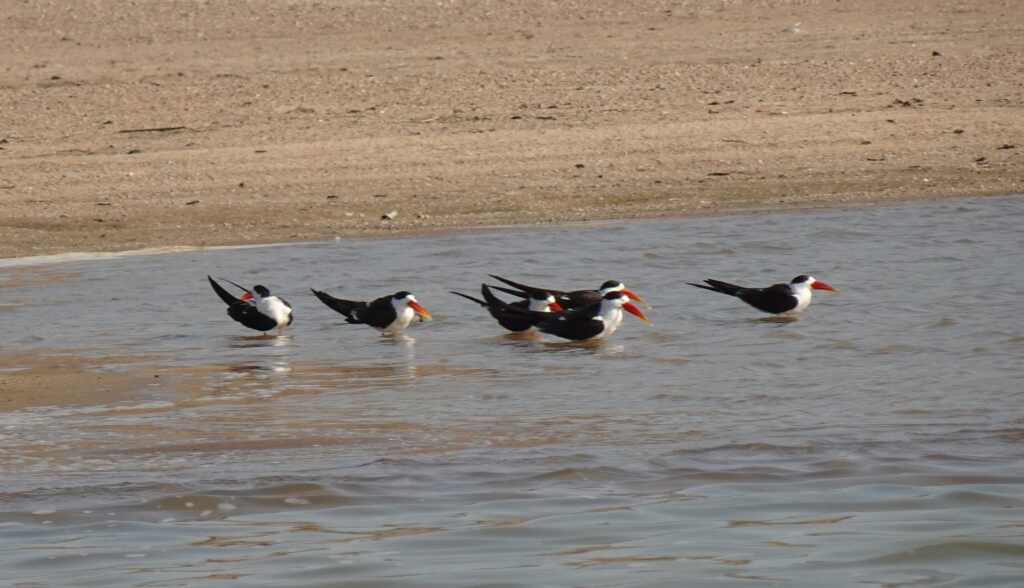
Over time, birders began noticing unusual behavioural patterns. Small flocks were observed congregating on mid-river sandbeds and displaying pre-breeding activities such as scrape formation, territorial displays, and pair bonding.
More recently, the situation has evolved further. In the Satkosia gorge, researchers and forest officials documented active nesting colonies on sandbars near Baladamara, marking the first confirmed breeding record of the species in this protected stretch of the Mahanadi.
Even more interestingly, a number of birds remained in the area beyond their usual winter migration period, suggesting a behavioural shift in seasonal movement.
This raises an important ecological question:
Are Indian Skimmers actively redistributing their breeding sites in response to pressures elsewhere?
Drivers of Behavioural Change
1. Loss of Traditional Breeding Grounds
Many traditional breeding areas of the Indian Skimmer across northern India have experienced severe ecological disruption. Activities such as sand mining, dam construction, and river channel modification have drastically altered river geomorphology.
These birds depend on open, undisturbed sandbars for nesting. When such sandbars disappear or become accessible to humans and livestock, breeding success declines sharply.
Studies monitoring over 230 nests along the Mahanadi revealed that nest failures frequently occur due to flooding, grazing animals, human disturbance, and sand extraction from river islands.
As a result, skimmers may be forced to search for new and more stable nesting habitats.
2. Refuge Effect of Protected River Corridors
The Satkosia gorge provides a rare ecological condition that is increasingly absent from many Indian rivers:
a relatively undisturbed river corridor.
The gorge stretches roughly 22 km along the Mahanadi, flanked by dense forest and protected within the Satkosia Tiger Reserve. The limited human activity in this landscape creates ideal conditions for riverine birds that rely on exposed sandbars.
Researchers have suggested that low biotic interference in this region may be a key factor encouraging skimmers to establish nesting colonies there.
In essence, Satkosia may function as a refuge landscape within an otherwise heavily modified river system.
3. Shifting Hydrological Dynamics
The breeding ecology of Indian Skimmers is closely tied to river hydrology. Their nesting season coincides with declining water levels during late winter and early summer, when sandbars emerge across the river channel.
In recent years, parts of the Mahanadi basin have shown extended low-water phases during pre-monsoon months, resulting in larger and more stable sandbanks. These geomorphological changes can temporarily create suitable nesting habitat.
However, such habitats remain fragile and can disappear quickly due to sudden water release from upstream barrages or early monsoon flooding.
The Emerging Metapopulation Along the Mahanadi
Another intriguing development is the formation of multiple skimmer activity zones along the Mahanadi.
Recent observations suggest that birds are using a network of riverine habitats, including:
- Munduli barrage stretch
- Kakhadi sandbeds
- Satkosia gorge sandbars
For example, large congregations of up to 300 individuals have been recorded nesting along sandbeds near Kakhadi, indicating that the Mahanadi basin may support a significant portion of the regional population.
Such spatial distribution hints at a metapopulation structure, where different colonies are connected through seasonal movement along the river.
Satkosia could function as one of the core nodes in this riverine network.
Behavioural Observations from the Mahanadi Landscape
Field observations across the Mahanadi belt reveal several notable behavioural patterns:
Delayed migration
Traditionally winter visitors, some individuals remain longer into the breeding season.
Colonial nesting with mixed species
Skimmers frequently nest alongside River Terns, Little Terns, and other sandbar-nesting birds, forming multi-species colonies.
Territorial scrape behaviour
Pairs create shallow depressions in the sand and defend them through aerial displays and aggressive posturing.
Flexible habitat use
Instead of using only traditional breeding sites, the birds appear to be experimenting with new sandbar locations along the river.
These behaviours suggest that Indian Skimmers may be showing adaptive flexibility in response to rapidly changing river ecosystems.
Conservation Implications
The increasing presence of Indian Skimmers in the Satkosia region carries significant conservation implications.
First, it highlights the importance of protecting free-flowing river stretches within protected landscapes.
Second, it underscores the need to treat river sandbars as critical breeding habitats, rather than empty wastelands often targeted for mining or grazing.
Finally, long-term monitoring of the Mahanadi population could provide valuable insight into how endangered riverine birds respond to environmental change.
If protected effectively, the Satkosia gorge may become one of the most important eastern refuges for the Indian Skimmer.
Conclusion: A River Telling a Story
The story unfolding along the Mahanadi is not simply about a rare bird appearing in a new place. It reflects a broader ecological narrative — one in which species are forced to adapt, relocate, and renegotiate their relationship with altered landscapes.
The Indian Skimmer, with its delicate dependence on river dynamics, may be acting as an indicator of deeper changes in India’s freshwater ecosystems.
In this sense, the sandbars of Satkosia are not merely nesting grounds.
They are signposts of a shifting river ecology.